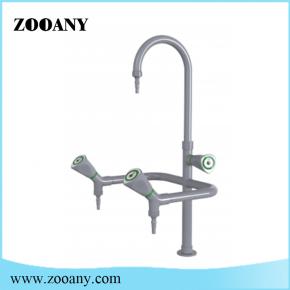
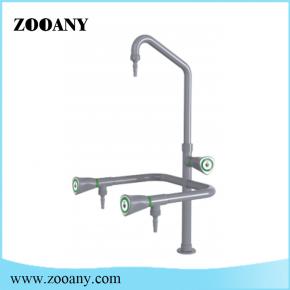
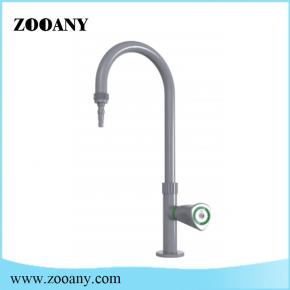
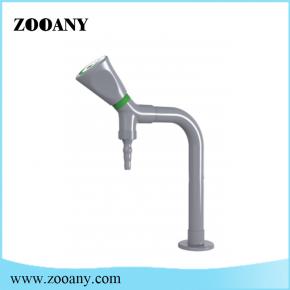
Color: gray, white
Body: Solid Brass
Surface treatment process: High gloss epoxy powder coating
Gooseneck: 360 degree rotating.
ZAKA2 Laboratory Double Outlet faucet
The main body of laboratory dual outlet faucets is usually made of high-purity copper, and the surface is treated with a matte epoxy resin acid alkali resistant powder coating, which can effectively resist the corrosion of chemical reagents such as acid and alkali, ensuring long-term use.

Body: Solid Brass
Surface treatment process: High gloss epoxy powder coating, resistant to most chemicals, UV fading & heat.
Ceramic headwork: 90 degree turn, 500,000 life cycles, water static pressure Max.10Bar.
Accessory: Detachable brass serrated nozzle, water flow control outlet attachable.
Nozzle: Brass or PP .

How to install a laboratory dual outlet faucet?
Installation steps
Preparation work:
Check accessories: Confirm that the faucet, gasket, nut, metal hose, etc. are complete, and check whether the faucet is damaged.
Tool preparation: Prepare tools such as wrenches, waterproof tape, hoses, etc.
Installation and fixation:
Insertion fixing: Insert the faucet into the reserved hole on the experimental platform from top to bottom, insert the upper gasket in sequence, tighten the fixing nut (be careful not to tighten too tightly), and finally install the decorative cover.
Connecting pipeline: Connect the metal hose to the faucet inlet.
Testing and inspection:
Check the seal: Open the water source and inspect all interfaces for water leakage. If there is leakage, turn off the water source and tighten the interface or wrap it with waterproof tape.
Test function: Confirm that the water flow at both outlets is normal and the switch is flexible.
Key precautions
Interface matching: It is necessary to confirm that the specifications of the faucet interface (such as G1/2 ") match the reserved holes on the experimental bench, otherwise a conversion joint needs to be used.
Pipeline fixation: After connecting the hose, it is recommended to use pipe clamps or zip ties for additional fixation to prevent detachment caused by water pressure.
Regular maintenance: The laboratory faucet is frequently used. It is recommended to regularly check whether the nut is loose and clean the water outlet to prevent blockage.
Safety Tips
Personal protection: It is recommended to wear gloves during installation to avoid sweat stains from corroding the surface of the faucet.
Standardized operation: Strictly follow the installation instructions to avoid damage caused by rough operation.
If you encounter specific problems during installation (such as interface mismatch or water leakage), please let me know the details at any time and I will help you find a solution.

Contact: Neil
Phone: +86-18205509969
E-mail: zooanylab@gmail.com
Add: 118, Building 3, Tianrun City Phase II, Tianchang City, Anhui Province. China